Back and Lay Betting on Playexch Explained
Understand exactly how back and lay betting works on a sports exchange — with plain-English examples, cricket scenarios, and the maths behind every price. Learn before you play. 18+ only.
18+ only. Play responsibly. Terms & Conditions apply.
What Is Back and Lay Betting?
Back and lay betting is the core idea that makes a sports exchange different from an ordinary bookmaker. When you back a selection you are betting that something will happen — a team wins, a batter passes a run total, a market settles a certain way. When you lay a selection you are betting that the same thing will not happen. On Playexch, both sides sit side by side, and the prices you see come from other users, not from a single house setting the line.
That one difference — being able to bet against an outcome, not only for it — is what gives exchange users more control. This guide explains how back and lay work, walks through worked examples with real numbers, and shows how the two sides connect. It is educational only; always play within your limits and follow local rules.
Back Betting: Betting That Something Will Happen
A back bet is the type of bet most people already know. You choose a selection, you place a stake, and if your selection wins you are paid out at the odds shown. If it loses, you lose your stake. On an exchange the mechanics are the same, but the price is set by supply and demand between users rather than by a bookmaker.
Exchange prices are shown as decimal odds. A price of 2.00 means your total return is twice your stake (your stake back plus an equal profit). A price of 1.50 means a smaller profit; a price of 5.00 means a larger one. The formula is simple:
- Potential return = stake × decimal odds
- Potential profit = stake × (decimal odds − 1)
So a ₹1,000 back bet at odds of 2.50 returns ₹2,500 in total if it wins — that is ₹1,500 profit plus your ₹1,000 stake. If it loses, you are down the ₹1,000 you staked, and nothing more. Your risk when backing is always limited to your stake.
🟦 Backing in one line
You bet for a selection. Win → paid at the odds. Lose → you lose your stake. Maximum risk = your stake.
🟥 Laying in one line
You bet against a selection. If it does not win, you keep the backer's stake. If it wins, you pay them out. Risk = your liability.
⚖️ Two sides, one market
Every lay is matched against a back. The exchange simply pairs users who disagree about an outcome at an agreed price.
Lay Betting: Betting That Something Will Not Happen
A lay bet is the part that is new to most people, and it is the real power of an exchange. When you lay a selection, you step into the shoes of the bookmaker for that single bet. You are accepting someone else's back bet. If their selection loses (or does not win), you keep their stake as your profit. If their selection wins, you have to pay them their winnings.
Two numbers matter when you lay:
- The backer's stake — the amount you win if the selection does not come in. This is your profit on a successful lay.
- Your liability — the amount you must pay if the selection does win. Liability = backer's stake × (lay odds − 1).
Here is the key mental shift: when you back, the odds tell you how much you can win; when you lay, the odds tell you how much you can lose. Laying at a low price (say 1.50) means small liability; laying at a high price (say 6.00) means large liability for the same stake. Always check the liability figure the exchange shows you before confirming a lay bet.
A Worked Cricket Example: Back vs Lay
Imagine a T20 match where a team is priced at 2.00 to win. Let us follow the same ₹1,000 through both sides so the difference is concrete.
If you BACK the team at 2.00 with ₹1,000
- Team wins → you receive ₹2,000 total (₹1,000 profit).
- Team loses → you lose ₹1,000.
If you LAY the team at 2.00 for a ₹1,000 backer stake
- Team loses → you keep the ₹1,000 backer stake (₹1,000 profit).
- Team wins → you pay ₹1,000 liability (₹1,000 loss).
Notice that backing and laying are mirror images. The backer's best case is the layer's worst case, and vice versa. At even odds (2.00) the profit and liability are equal, which makes the mirror easy to see. At other prices the numbers change, but the principle never does: one side wins exactly what the other side loses, minus a small commission on net winnings.
Understanding Liability Before You Lay
Liability is the single most important number for anyone new to lay betting, because it can be larger than the amount you expect to win. Suppose you lay a heavy favourite at odds of 1.25 for a ₹2,000 backer stake. Your potential profit is ₹2,000, but your liability is only ₹2,000 × (1.25 − 1) = ₹500. Laying short-priced favourites means small liability for a large-looking stake.
Now flip it. If you lay an outsider at odds of 7.00 for the same ₹2,000 backer stake, your liability is ₹2,000 × (7.00 − 1) = ₹12,000. You would be risking ₹12,000 to win ₹2,000. That is why laying long-shots is high-risk: the outcome is unlikely, but if it lands, the payout is heavy. A responsible exchange user always reads the liability figure the platform displays and never lays more than they can comfortably afford to lose.
💡 Backing tip
Your risk is fixed at your stake. Good for straightforward "I think this will happen" bets.
⚠️ Laying tip
Your risk is your liability, which can exceed the profit. Always check it before you confirm.
📊 Odds tip
Low odds = likely outcome, small reward. High odds = unlikely outcome, big reward or big liability.
🔁 Green-up tip
You can back and lay the same selection at different prices to lock a position. Advanced — learn slowly.
Matched Betting and Locking a Position
Because an exchange lets you sit on both sides of a market, experienced users sometimes back a selection and later lay the same selection (or the reverse) once the price has moved. If the price shortens after you back it, laying it back at the lower price can lock in a guaranteed position regardless of the final result — a technique traders call "greening up."
This is genuinely useful to understand, but it is not a shortcut to guaranteed money. Prices move for real reasons — wickets fall, a chase gets easier, a favourite is substituted — and the spread between back and lay, plus commission, eats into any margin. Treat trading as a skill that takes practice and patience, not as a guaranteed-win system. There is no such thing as a risk-free bet, and anyone promising one should be treated with caution.
How Back and Lay Prices Get Matched
An exchange is essentially a marketplace. On one side are users offering to back a selection at a price; on the other are users offering to lay it. When a back request and a lay offer meet at the same price, the bet is matched and both users are now in the market. If no one is offering your price yet, your bet sits unmatched until someone takes the other side, or you cancel it.
This is why you sometimes see the amount available at each price. A large amount available means plenty of liquidity — you can get matched quickly. A thin market means you may have to accept a slightly worse price to get matched, or wait. For a deeper look at how these numbers are displayed, read our companion guide on how to read exchange odds. Cricket users should also see session and fancy bets explained, which behave differently from standard match-odds markets.
How Commission Works on Back and Lay Winnings
An exchange does not shade the odds the way a traditional bookmaker does. Instead, it charges a small commission on your net winnings in a market. If you finish a market down, you pay no commission at all — commission only ever applies to profit. This matters for both backing and laying, because it slightly reduces what you keep from a winning position.
Suppose you back a selection and finish a market ₹1,000 in profit. If commission were charged at, say, 2%, you would keep ₹980 and the platform retains ₹20. The same principle applies to a winning lay: the profit you take from a backer is reduced by the commission rate on your net win. Because commission is charged on net rather than on turnover, it never turns a winning position into a losing one — but it does mean that very thin trading margins can be eaten up entirely. Always factor commission into any back-and-lay "trade" before assuming a locked profit. The exact rate is shown in your account terms; check it there rather than assuming a figure.
Placing Your First Back Bet: Step by Step
If you have never used an exchange before, the mechanics become obvious after one bet. Here is the sequence in plain terms — practice with small amounts first.
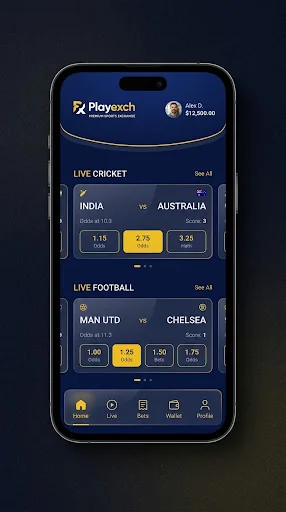
- Open the market. Choose a match and open a market such as Match Odds. You will see each selection with a back price and a lay price side by side.
- Pick your side. To bet that a team will win, use the blue back price. To bet that it will not, use the pink lay price.
- Enter your stake. Type the amount you want to risk (for a back) or the backer stake you are accepting (for a lay). The screen instantly shows your potential profit and, for a lay, your liability.
- Check the numbers. Confirm the odds, the profit and — crucially for a lay — the liability. Never skip this step.
- Place the bet. Submit it. If a user is offering the opposite side at your price it matches immediately; otherwise it stays unmatched until someone takes it or you cancel.
- Watch it settle. When the market resolves, winnings (minus commission) are credited automatically.
Start with the smallest stakes while you learn. There is no rush, and understanding one market well is worth more than spreading small bets across many.
A Quick Glossary of Back and Lay Terms
- Back — a bet that a selection will happen. Risk is your stake.
- Lay — a bet that a selection will not happen. Risk is your liability.
- Liability — the amount you must pay if a lay bet loses; equals backer stake × (lay odds − 1).
- Matched / unmatched — whether another user has taken the opposite side of your bet yet.
- Decimal odds — the price format used on exchanges; total return per unit staked.
- Liquidity — how much money is available to bet at each price. High liquidity means faster matching.
- Commission — a small percentage charged on net winnings in a market.
- Green up / trade — backing and laying the same selection at different prices to lock a position.
Back and Lay: Common Mistakes to Avoid
- Ignoring liability. New users focus on the profit and forget the liability figure. Always read both before confirming a lay.
- Laying big outsiders casually. A high lay price means a high liability. The rare time it lands can wipe out many small wins.
- Chasing losses. Increasing stakes to "win it back" is the fastest route to trouble. Set a limit and stick to it.
- Confusing back and lay buttons. Take a moment to confirm which side you are on — the platform colour-codes them for a reason.
- Betting money you need. Only ever stake funds you can afford to lose entirely. This is entertainment, not income.
🛡️ Play safe
Set deposit and time limits before you start. Read our responsible use guide.
🆔 Get started
New here? The Playexch ID guide explains how account access works.
🔐 Sign in
Already set up? The Playexch login guide covers safe sign-in.
Related Playexch Guides & Articles
Keep learning the exchange with these closely related guides:
- Exchange odds explained — decimal prices, commission and liability in detail
- Session and fancy bets explained — cricket-specific run markets
- Playexch ID guide — how account access works
- Playexch 247 access guide — round-the-clock markets
Frequently Asked Questions
What is the difference between back and lay betting?
Backing means betting that a selection will happen; laying means betting that it will not. When you back, your risk is your stake and your reward is set by the odds. When you lay, your reward is the backer's stake and your risk is your liability, which can be larger than the stake.
Is lay betting riskier than backing?
It can be, because your liability may exceed your potential profit — especially when you lay a selection at high odds. Laying short-priced favourites carries small liability; laying outsiders carries large liability. Always read the liability figure the exchange shows before confirming.
What are decimal odds?
Decimal odds show your total return per unit staked. Odds of 2.00 return twice your stake if the bet wins (stake plus equal profit). Multiply your stake by the decimal odds for the total return, or by (odds − 1) for the profit.
What does it mean when a bet is "unmatched"?
An exchange bet only becomes active when another user takes the opposite side at your price. Until then it is unmatched and can be cancelled. A matched bet is one that has been paired with a backer or layer.
Can I both back and lay the same selection?
Yes. Backing and then laying the same selection at a different price is how users lock in or "trade" a position. It requires understanding of price movement and commission, and it is not a guaranteed-profit method.
Is there any guaranteed way to win with back and lay betting?
No. There is no guaranteed-win system. Prices move for real reasons, commission applies to net winnings, and every bet carries risk. Treat the exchange as entertainment, set limits, and only stake what you can afford to lose. 18+ only, and always follow the rules that apply where you live.
Need Help Getting Started on Playexch?
Our support channel can walk you through account access and answer your questions. Reach out any time — and remember to play responsibly, 18+ only.
Contact Support