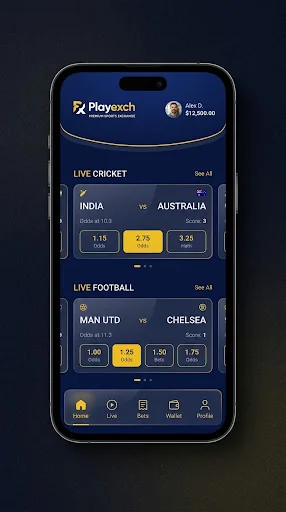
Play Exch Cricket: Markets, Odds Movement and Access
How cricket markets actually work on the Playexch exchange — match odds, the toss, session runs, and why a single wicket moves the price.
18+ only. Play responsibly. Terms & Conditions apply.
Play exch cricket access means using your Playexch ID to view and trade cricket markets on the exchange — backing or laying a team, an innings total, or the toss, at prices set by other users rather than by a bookmaker. This article covers the cricket-specific side: which markets you will see, how a match changes the numbers, and what to watch in-play.
If you are new to the idea of an exchange itself — what backing and laying mean, how decimal odds are read, what liquidity and commission are — start with Play Exch explained: how a betting exchange works. That page covers the mechanics in plain English. This one assumes you have the basics and focuses purely on cricket.
18+ only. Cricket markets move fast and nothing here predicts results or promises a profit. Please read our responsible use information before you trade.
Ready to Get Started With Cricket Markets?
Message the official Playexch support channel to set up your ID.
Get Your Playexch IDWhy Play Exch Cricket Suits an Exchange So Well
Cricket is unusually well matched to exchange trading, and it is worth understanding why before you place anything. A cricket match is long, it is broken into discrete events, and each event carries real information. A wicket, a boundary, a rain break or a change of bowler all shift the likely outcome — and because an exchange price is just the crowd's live opinion, that price shifts with it.
Compare that to a sport where scoring is rare and the state changes slowly. Cricket gives you a price that is genuinely alive across several hours. That is the appeal, and it is also the risk: a market that moves this much can move against you just as easily as for you.
Ball-by-Ball Events
Every delivery is a discrete event that can change the match state. Prices update continuously through an innings rather than sitting still.
Long Format Window
A T20 runs about three hours and a Test runs for days, so there is a long window in which opinion — and therefore price — can change.
Deep Public Interest
Major cricket draws heavy participation, which is what creates the liquidity that makes a market usable at all.
The Play Exch Cricket Markets You Will Commonly See
Play exch cricket markets are typically grouped by what they settle on. Availability varies by match, competition and format — a domestic T20 will not carry the depth an international fixture does — so treat the list below as the common shape rather than a guarantee of what is open on any given day.
Match Odds
The core market: which side wins. In limited-overs cricket this is usually two outcomes; in Test cricket a draw is a genuine third outcome, which is why Test match-odds markets behave very differently. Backing a team means you want them to win. Laying them means you are taking the other side — you win if they do not.
Toss Winner
A coin flip, so the price sits near even money and barely moves on form. It settles quickly and is often the first market to close. It carries no skill edge — it is chance, and worth understanding as exactly that.
Completed Match
Settles on whether the match reaches a legitimate conclusion at all. This is a weather market in practice. In a rain-affected competition it can be more active than you would expect, because an abandoned game changes how everything else settles.
Innings Runs and Session Markets
These settle on runs scored in a defined block — a full innings, the powerplay, or a set number of overs. They are popular precisely because they resolve within the match rather than at the end of it. They are also where the price swings hardest: a single over can rewrite the expected total.
Top Batsman and Top Bowler
Settles on the individual with the most runs or wickets for a side. These are generally thinner markets with wider gaps between the back and lay price, which means getting matched at the number you want is harder.
Questions About a Specific Cricket Market?
The official Playexch support channel can walk you through what is available.
Contact SupportHow a Cricket Innings Moves the Price
This is the part that separates cricket from every other sport on the exchange. The price is not tracking the score — it is tracking the resources a side has left. In limited-overs cricket those resources are wickets in hand and balls remaining, and the market prices both at once.
A side needing 60 from 40 balls with eight wickets standing is in a completely different position from a side needing 60 from 40 balls with two wickets standing, even though the required run rate is identical. That is why a wicket can move a price sharply while a dot ball barely registers, and why the same wicket falling in the fourth over and the eighteenth over produces two very different reactions.
Four things tend to move cricket prices more than anything else:
Wickets
The single biggest mover in limited-overs cricket. Losing a set batter late in a chase can swing a match-odds price further than twenty runs would.
Required Rate
As balls run out, the rate needed climbs and the market reprices. Late in a chase, each over without runs compounds the pressure.
Weather and Light
Rain does not just pause a match — it can rewrite the target under a revised-target calculation, or void the game entirely.
Pitch and Conditions
A surface that grips or a ball that swings under lights changes what a par score is, and the market adjusts to that read.
T20, ODI and Test — Three Different Markets
Treating all cricket as one thing is the most common beginner mistake. The format changes the behaviour of the price completely.
T20 is the most volatile. With only 120 balls a side, every over is a meaningful share of the innings, and a single big over can flip a match-odds price. Liquidity is usually strongest here because the audience is largest, but the speed means an in-play price can be gone before you have finished reading it.
ODI cricket moves more gradually. Fifty overs gives a side room to recover from a bad passage, so the market is slower to write anyone off. Prices tend to drift rather than jump, with the sharpest movement in the closing ten overs.
Test cricket is its own world. The draw is a live outcome, so a dominant side may still be priced cautiously on day two simply because there is time for weather or a rearguard to intervene. Test prices can sit almost still for a session and then move hard in an hour.
Play Exch Cricket In-Play: The Delay Is Real
The most important practical warning in play exch cricket trading is this: your video feed is behind the ground. A television or streaming picture typically lags live play by several seconds, and an internet stream can lag further still.
That gap matters. If you react to a wicket you have just seen on screen, the market has usually already reacted — people at the ground, and automated systems reading faster data, moved first. The price you are looking at may be stale by the time your bet reaches the queue, which is a common reason an in-play bet goes unmatched or matches at a worse number than expected.
There is no way to eliminate that delay. The realistic responses are to trade in-play with smaller amounts than you would pre-match, to accept that you are not going to beat the fastest data to a reaction, and to avoid chasing a price that has already moved. Being late to a wicket is normal. Betting into it anyway is where money goes.
Play Exch Cricket Liquidity Varies More Than You Think
Liquidity is the money actually available to match against you. On an exchange your bet does nothing until someone takes the other side, and play exch cricket liquidity is wildly uneven.
A marquee international or a major T20 league fixture will usually have deep match-odds liquidity — you can get matched near the shown price without much trouble. A minor domestic game, an obscure league, or a niche market like top bowler may have very little. In a thin market the gap between the back price and the lay price widens, and pushing a larger amount through can move the price against you as you fill.
The practical read: check whether a market is genuinely liquid before you plan around it, and be aware that liquidity in cricket collapses quickly outside the headline fixtures and the headline markets.
Trading Play Exch Cricket Responsibly
Cricket's pace is exactly what makes it risky. A market that reprices every over invites constant action, and constant action is how a session gets away from someone. None of what is above is a system, and understanding a market does not make its outcome predictable — a wicket is not something you can foresee.
Decide what you are prepared to lose before the toss, not during the death overs. Treat any loss as final rather than as something to win back in the next session market. If it stops being entertainment, stop. Our responsible use page sets out the limits and support options in full, and bankroll basics covers staking in more depth.
18+ only. Please follow the laws that apply where you are. Playexch does not promise winnings, and no article on this site should be read as advice to bet.
Frequently Asked Questions
What does play exch cricket access actually involve?
It means using your Playexch ID to reach cricket markets on the exchange — viewing live prices, and backing or laying outcomes such as match odds, the toss or an innings total, against other users rather than against a bookmaker.
Which play exch cricket market should a beginner look at first?
Match odds on a well-known fixture is the most straightforward, because it settles on one clear question and usually has the deepest liquidity. Watch it for a match or two without placing anything to see how the price responds to wickets and overs.
Why did a price move so much on one wicket?
Because the market prices wickets in hand as a resource, not just runs. Losing a set batter reduces a side's ability to score for the rest of the innings, so the whole projection shifts — particularly late in a chase.
Why is my in-play cricket bet not getting matched?
Usually the delay on your video feed. The market has already reacted to what you are watching, so the price you clicked no longer exists. It can also mean the market is thin and nobody is offering the other side at your number. See our login and access help if the problem is the account itself rather than the market.
Can I trade cricket markets on my phone?
Yes — the exchange is built to work in a mobile browser. Our mobile access guide explains how to reach it on Android and iPhone and what to check before installing anything.
Are the same play exch cricket markets open for every match?
No. Market availability and depth depend on the fixture, the format and the competition. A major international carries far more than a minor domestic game.
Does understanding cricket markets mean I will win?
No. Understanding how a market prices a match helps you read what you are looking at, but cricket outcomes are uncertain and no knowledge removes that. Never trade money you cannot afford to lose.
Where to Go Next
Build the foundation in this order:
- How a betting exchange works — back, lay, odds, liquidity and commission explained from scratch.
- Your Playexch ID — what the account is and how access is set up.
- Creating your ID step by step — the practical walkthrough.
- Round-the-clock access — useful when you are following cricket in another time zone.
- Cricket ID safety checklist — protecting the account itself.
Start With Play Exch Cricket
Message the official Playexch support channel to set up your ID and get access to live play exch cricket markets. 18+ only.
Get Your Playexch ID